


Latest blog
A Complete Guide to Mobile Crushing Stat... Unstable Primary Crushing in Large Mines... How to Choose a Reliable Crusher Manufac... Crushers: Classification, Selection Prin... Performance advantages of tire‑mounted m... What are the characteristics of tire‑mou...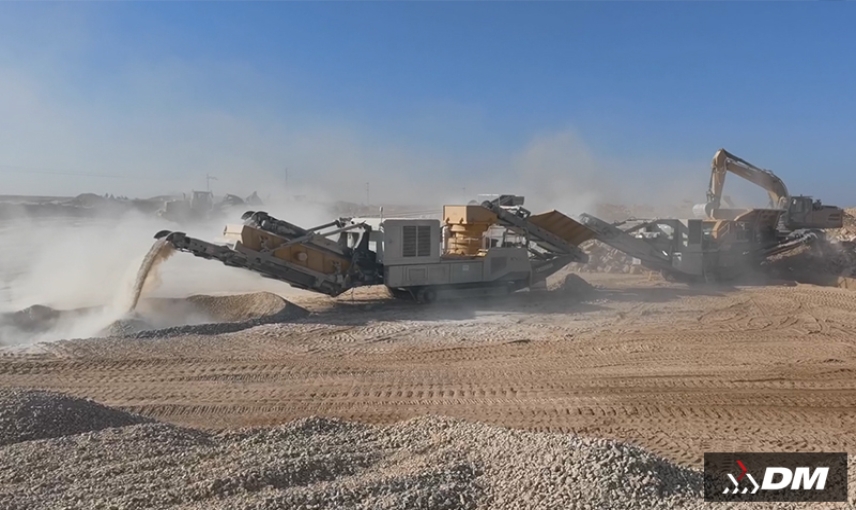
How Does a Mobile Crusher Work?
In numerous fields such as mineral mining, building demolition, and road construction, mobile crushers have emerged as the "main force" in crushing operations, thanks to their core advantages of flexibility and high efficiency. Compared with traditional fixed crushing equipment, they do not require complex foundation construction and can directly enter the job site, significantly reducing material transportation costs and time consumption. So, how does this equipment, which combines flexibility and strong performance, complete the crushing operation? This article will detail its working process and core mechanism for you.
I. Core Composition of a Mobile Crusher: A "Golden Combination" for Collaborative Operation
A mobile crusher is not a single device but an integrated system composed of multiple functional modules. Each module performs its own duties while cooperating closely, jointly completing the entire process from raw material feeding to finished product discharge. Its core composition mainly includes:
- Feeding System: Usually composed of a vibrating feeder, it is responsible for uniformly and continuously feeding raw materials such as ores and stones to be crushed into the crushing main machine. It avoids equipment blockage caused by raw material accumulation and provides a stable material supply for the subsequent crushing process.
- Crushing System: This is the "heart" of the equipment. Different types of crushing main machines, such as jaw crushers, impact crushers, and cone crushers, can be configured according to crushing requirements. Different main machines adopt different crushing principles to adapt to the crushing of materials with different hardness and sizes.
- Sieving System: Composed of a vibrating screen, it is used for classifying and screening the crushed materials. Materials that meet the particle size requirements will be discharged as finished products, while materials that do not meet the standards will be sent back to the crushing main machine for secondary crushing, ensuring the uniformity of the finished product quality.
- Conveying System: Including belt conveyors and other equipment, it is responsible for conveying the raw materials from the feeding system to the crushing main machine, then transferring the crushed materials to the sieving system, and finally conveying the finished materials to the designated position, forming a complete material circulation channel.
- Power and Control System: It uses a diesel engine or an electric motor as the power source to provide energy for the operation of the entire equipment; the control system realizes intelligent regulation of each module. Operators can easily set crushing parameters and monitor the equipment operation status through the control panel.
II. Complete Working Process: A "Transformation Journey" from Raw Material to Finished Product
The working process of a mobile crusher is closely linked, with each link connecting accurately to ensure efficient and stable crushing operations. The specific process can be divided into the following six steps:
Step 1: Raw Material Pretreatment and Feeding
Before operation, operators will simply screen the raw materials to remove impurities such as metals and wood to avoid damaging the equipment. Subsequently, the raw materials are sent to the vibrating feeder, which uniformly distributes the raw materials through high-frequency vibration and continuously conveys them to the feed port of the crushing main machine. During this process, the vibration frequency of the feeder can be adjusted according to the material characteristics and crushing requirements to ensure the stability of the feeding amount.
Step 2: Primary Crushing (Coarse Crushing)
After the raw materials enter the crushing main machine, primary crushing is carried out first. If a jaw crusher is used as the coarse crushing equipment, it exerts extrusion and shearing forces on the raw materials through the periodic opening and closing of the movable jaw and the fixed jaw, crushing large pieces of raw materials to a medium particle size. The jaw crusher has a deep crushing cavity and a wide feed port, which can adapt to the crushing of large-sized raw materials and is a common choice for primary crushing. The crushed materials are discharged through the discharge port of the main machine and enter the next link.
Step 3: Secondary Crushing (Medium/Fine Crushing)
If the materials after coarse crushing do not meet the finished product requirements, they will be conveyed to the secondary crushing equipment for further crushing. At this time, impact crushers or cone crushers can be selected according to the material hardness and finished product particle size requirements. The impact crusher uses a high-speed rotating rotor to drive the blow bar to impact the materials, making the materials collide and crush repeatedly between the blow bar and the impact plate, which is suitable for medium and fine crushing of materials below medium hardness; the cone crusher crushes the materials through the relative movement of the movable cone and the fixed cone, which is suitable for medium and fine crushing of hard materials. Through secondary crushing, the particle size of the materials is further reduced, approaching the finished product standard.
Step 4: Sieving and Classification
The mixed particle size materials after crushing are conveyed to the vibrating screen, which makes the materials move back and forth on the screen surface through high-frequency vibration. According to the preset screen mesh aperture, the materials that meet the particle size requirements (finished products) will fall into the belt conveyor below through the screen mesh, while the unqualified materials with larger particle sizes are intercepted by the screen surface and sent back to the crushing main machine (can be sent back to secondary crushing or primary crushing, depending on the particle size) through the return belt conveyor for secondary crushing, forming a closed-loop system of "crushing - sieving - return" to ensure the maximum utilization of materials.
Step 5: Finished Product Conveying and Stacking
The finished materials after sieving are conveyed to the designated finished product stacking area by the belt conveyor, or directly loaded into transport vehicles and transported to the construction site. Some mobile crushers can also be equipped with multiple belt conveyors to realize the classified stacking of finished products with different particle sizes, meeting the diverse needs of subsequent construction.
Step 6: Intelligent Equipment Monitoring and Adjustment
During the entire working process, operators can real-time monitor the operating parameters of the equipment through the control system, such as feeding amount, crushing pressure, motor temperature, vibration frequency, etc. If there are situations such as excessive feeding leading to excessive equipment load or the finished product particle size not meeting the requirements, the system will issue an early warning in a timely manner. Operators can adjust parameters such as feeding speed and crushing gap to ensure stable equipment operation and guarantee the quality of finished products.
III. Technical Support Behind Core Advantages
The efficient working capacity of mobile crushers is inseparable from the support of their core technologies. On the one hand, the modular design allows each system to be flexibly combined, and the equipment configuration can be quickly adjusted according to different operation scenarios; on the other hand, the application of the intelligent control system realizes the automation and precision of operations, reduces the cost of manual intervention, and improves the operation efficiency. In addition, the mobile chassis of the equipment is made of high-strength steel, combined with a large-diameter tire or crawler design, which enables it to move flexibly in complex terrain and easily adapt to harsh operating environments such as mines and construction sites.
IV. Application Scenarios: Flexibly Adapting to Diverse Needs
With its unique working mechanism and advantages, mobile crushers are widely used in various scenarios: in mineral mining, they can directly complete ore crushing at the mining point, reducing ore transportation costs; in building demolition sites, they can quickly crush construction waste such as concrete and bricks to realize resource recycling; in road construction projects, they can crush stone materials on-site to produce road construction materials that meet the requirements, improving construction efficiency.
As a professional mineral processing machinery manufacturer, our mobile crushers not only perform excellently in work efficiency and stability but also can be customized according to your specific needs to provide you with efficient and economical crushing solutions. No matter what kind of crushing problems you are facing, we can match you with the most suitable equipment to help you improve work efficiency and reduce production costs.


We will answer your email shortly!