


Latest blog
Unstable Primary Crushing in Large Mines... How to Choose a Reliable Crusher Manufac... Crushers: Classification, Selection Prin... Performance advantages of tire‑mounted m... What are the characteristics of tire‑mou... Mobile Crushing Station: Advantages, Typ...
What is a crusher machine used for?
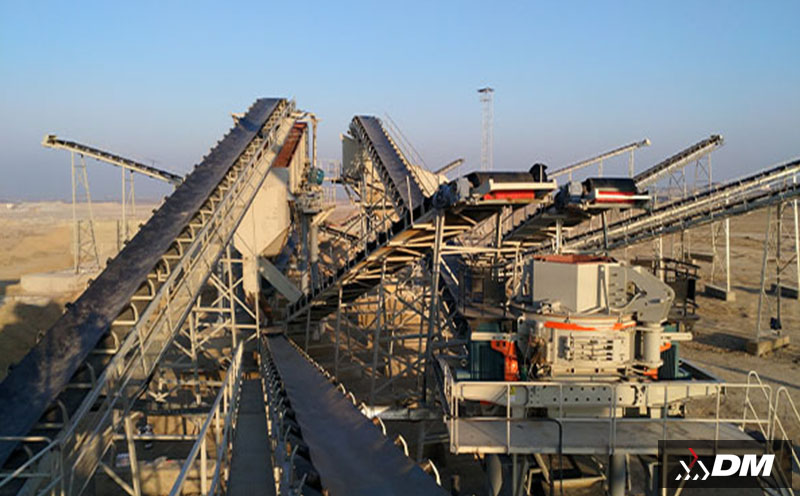
A crusher machine is a general-purpose equipment widely used in multiple fields such as mining, construction, metallurgy, chemical industry, and general solid waste treatment. Its core function is to crush large pieces of solid materials (such as ore, rock, concrete, scrap steel, wood, etc.) into small pieces, particles, or powder that meet usage requirements, so as to facilitate subsequent processing, transportation, recycling, or reuse.
I. Core Uses of Crusher Machines
-
1. Material Volume Reduction and Facilitation of Transportation
Uncrushed large materials are bulky and heavy, resulting in high transportation costs and low efficiency. After being crushed by a crusher machine, the volume of materials is significantly reduced, which not only saves transportation space and reduces transportation costs, but also avoids safety problems such as jamming and falling of large materials during transportation.
-
2. Meeting the Requirements of Subsequent Processing Technologies
In industrial production, many processes have strict requirements on material particle size. For example:
- In mining, ore must be crushed to a specified particle size before entering a ball mill for grinding and beneficiation;
- In the construction industry, concrete aggregates need to be crushed into stones of different specifications for mixing concrete;
- In the resource utilization of solid waste, crushed waste concrete and waste bricks can be made into recycled aggregates for road subbase, brick making, etc.
-
3. Resource Recovery and Recycling
Crusher machines are one of the core equipment for solid waste resource utilization. For example, waste metals, waste plastics, waste wood and other materials can have impurities removed and uniform particle size achieved after crushing, which facilitates subsequent sorting, recovery and reprocessing, realizes resource recycling, and reduces environmental pollution.
II. Application Fields of Crusher Machines
According to different processed materials and usage scenarios, crusher machines are applied in various industries:
- Mining industry: crushing mineral resources such as iron ore, limestone, granite, coal;
- Solid waste industry: treating decoration waste, construction waste, concrete blocks, tiles, etc., to produce recycled building materials;
- Metallurgical industry: crushing metallurgical waste such as scrap steel, scrap copper, slag;
- Environmental protection industry: treating domestic waste and industrial solid waste to achieve reduction and resource utilization;
- Chemical industry: crushing chemical raw materials to meet the requirements of refined processing.
III. Summary
The core value of a crusher machine lies in changing the particle size of materials through physical means, transforming them from "large pieces that cannot be directly used" into "small particles that meet the requirements of industrial production and resource recovery". It is an indispensable key equipment in the chain of industrial production and resource recycling. Different types of crusher machines (such as jaw crusher machines, cone crusher machines, impact crusher machines, etc.) are adapted to different usage scenarios according to material hardness, discharge particle size requirements, etc.
From Crushing to Regeneration: A Detailed Explanation of General Solid Waste Treatment Solutions
The treatment of general solid waste (including construction waste, decoration waste, industrial leftover materials, waste wood, etc.) is one of the core issues in the field of environmental protection. Among them, decoration waste has become a key and difficult point in urban general solid waste treatment due to its rapid growth and complex composition. A complete general solid waste treatment solution needs to focus on the core goals of "reduction, resource utilization, and harmlessness", covering the entire process from source classification to recycling. This article will detail this system combined with practical cases of decoration waste treatment.
I. Core Background and Principles of General Solid Waste Treatment
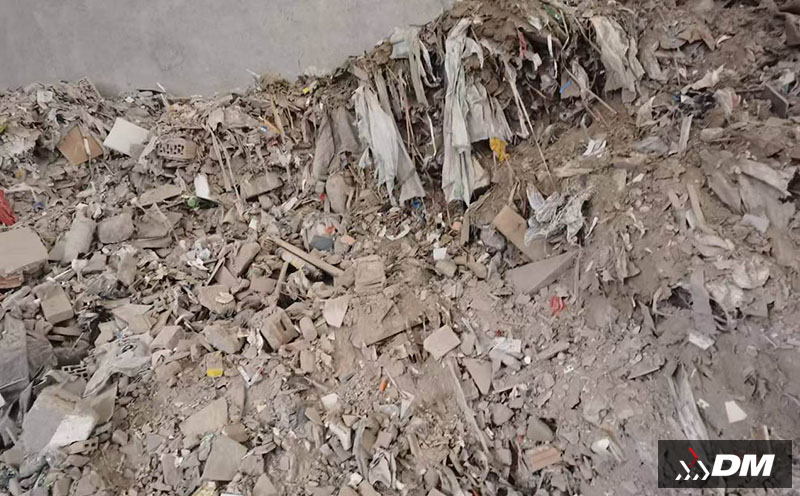
With the acceleration of urban renewal, decoration waste comes from scenarios such as renovation of residential buildings and office buildings, replacement of shops in commercial complexes, renovation of hotels and homestays, and maintenance of schools and hospitals. Its composition is both complex and diverse: it includes inert materials such as sand, gravel, tiles, wood, glass, metal, as well as formaldehyde-containing adhesives/man-made boards, heavy metal-containing waste paint/coating packaging, plasticizer-containing wallpaper/plastic pipes, and hazardous waste such as waste fluorescent tubes and waste batteries. Based on this, the treatment of general solid waste must follow three core principles:
- Reduction: reducing the volume of solid waste through physical means such as crushing and compression, and lowering transportation and disposal costs;
- Resource utilization: maximizing the extraction of available resources from solid waste to achieve circular regeneration;
- Harmlessness: avoiding secondary pollution during the treatment process, separating hazardous waste and disposing of it in compliance with regulations, and meeting environmental protection emission standards.
II. Detailed Disassembly of the Entire Process of General Solid Waste (Decoration Waste) Treatment
-
1. Solid Waste Collection and Classification
In view of the complex composition of decoration waste, inert materials and hazardous waste should be distinguished at the source. Resourceable materials such as sand, gravel, tiles, metal should be collected separately from hazardous waste such as waste batteries and waste fluorescent tubes. After being transported to a professional treatment plant, secondary pre-sorting is carried out.
-
2. Modular Intelligent Crushing and Sorting
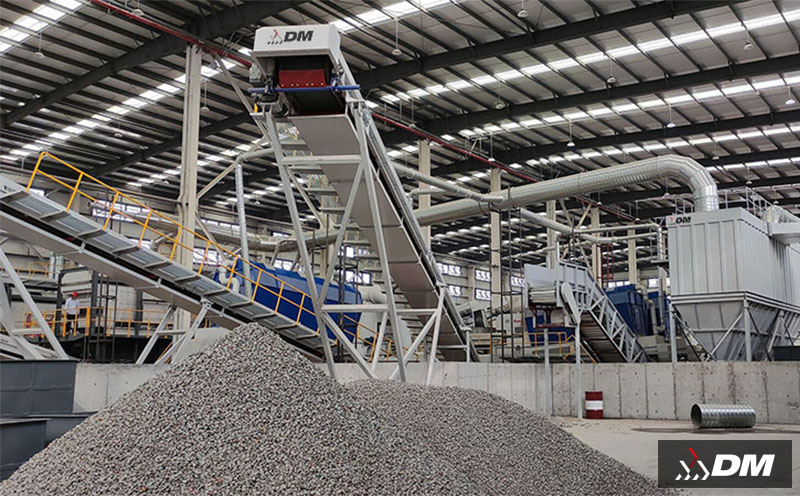
Taking the decoration waste treatment solution of Shanghai Dongmeng as an example, the production line adopts a three-dimensional layout and an integrated design of four functional modules to build core processing capabilities:
- Manual sorting: accurately removing hazardous waste such as waste batteries and waste fluorescent tubes;
- Screening: separating aggregates of different particle sizes to prepare for subsequent regeneration;
- Light material sorting: separating light materials such as plastics and wood chips through air separation and other processes;
- Fine crushing: crushing hard materials such as sand, gravel and tiles to specified particle sizes such as 0-12mm and 12-31.5mm.
-
3. Full-Category Resource Utilization
After treatment, all components of decoration waste have clear resource utilization outlets, realizing a closed loop from "waste" to "resource":
- Utilizable aggregates: 0-12mm and 12-31.5mm recycled aggregates, used as subgrade fillers or for producing permeable bricks, slope protection bricks and other building materials;
- Metal: sorted steel, aluminum alloy, copper and other metals are packed and sold externally to be smelted into new building profiles and hardware parts;
- Light materials such as plastics: cleaned and granulated to make recycled plastic particles for producing pipes and building formwork;
- Bamboo and wood: intact parts are supplied to man-made board factories, and the rest are used as biomass fuel for power generation and heating;
- Combustibles: compressed and packed and sent to incineration plants for power generation, or made into RDF fuel for industrial facilities;
- Soil and ash: used for road base and site backfilling to replace natural earthwork.
III. Core Highlights of General Solid Waste Treatment Solutions
- Modular intelligent design: compact layout, independent operation and centralized monitoring of each module, intelligent speed regulation to reduce energy consumption, and convenient maintenance;
- Full controllability of environmental protection and safety: complying with national emission and total quantity control requirements, key sections equipped with dust suppression and noise reduction facilities, multiple electrical protection and emergency stop systems to ensure operational safety;
- High-value resource recovery: accurately separating various recyclable materials through multi-stage processes of "pre-sorting + screening + air separation + crushing" to achieve full-category resource utilization;
- Compliant and harmless disposal: abiding by national environmental protection and safety standards throughout the process, disposing of hazardous waste separately to avoid secondary pollution.
IV. Value and Significance of General Solid Waste Treatment
The general solid waste treatment system represented by Shanghai Dongmeng's full-process resource utilization solution for decoration waste not only solves the governance pain points of urban decoration waste disposal, but also achieves multiple values: reducing the amount of solid waste landfilling and lowering environmental pollution; saving natural resources such as sand, gravel and metal ores; creating additional economic benefits for enterprises; helping cities achieve the "dual carbon" goals and sustainable development.
V. Summary
The treatment of general solid waste from crushing to regeneration is core to customizing modular and intelligent treatment solutions combined with material characteristics (such as the complex composition of decoration waste). Through the full-process design of "collection - sorting - crushing - regeneration", the ultimate goals of "reduction, resource utilization, and harmlessness" are achieved. The implementation of such solutions transforms general solid waste from an "urban burden" into "renewable resources", providing solid support for the green development of cities.


We will answer your email shortly!